We help your calendars, tasks, and energy levels agree on a realistic focus schedule.
How Sarivorelia fits into your week and your responsibilities
The info page is where we slow down and explain how Sarivorelia actually works. Instead of treating AI as a black box that magically fixes your calendar, we unpack the steps, decisions, and trade offs involved in AI integrated focus scheduling. You will see how we map your energy levels, how the assistant coordinates multiple calendars and task systems, and how we keep you in control of changes. We also point to supporting documents, updated for 2026, that cover cookies, privacy, and legal disclaimers so you can understand the wider context. Throughout, we emphasise that results may vary because every work environment and personal situation is different, and we encourage you to treat this page as a starting point for thoughtful experiments rather than as a promise of a single perfect schedule.

Connecting your tools
Connect tools carefully, test gently, and expand only when the results feel honest and sustainable
When you connect calendars and task tools to Sarivorelia, we encourage you to start small. You might link a primary work calendar and a single task list, then allow the AI assistant to propose only a few focus blocks on days you already expect to be quieter. As you see how those suggestions behave, you can add more calendars, broaden the rules, or tighten boundaries. This gradual approach keeps experiments safe, reversible, and grounded in your reality rather than in an idealised template.
Ask a questionUnderstanding Sarivorelia in more detail
A practical guide to what our AI assistants actually do with your schedule

On this page we walk through how Sarivorelia thinks about AI integrated focus scheduling, what it actually does with your calendars, and where its limits are. We focus on concrete examples rather than abstract promises, so you can decide whether this kind of assistant fits the way you already work in South Africa or elsewhere.
We start with your real week: which meetings move, where interruptions cluster, and when your thinking feels clearest. From there we design simple rules that an AI assistant can follow to reserve focus blocks, negotiate conflicts, and surface trade offs. You stay in charge of which tools connect, which events are flexible, and how much autonomy the assistant has to change your schedule. Results may vary, and we describe that openly.
Because calendars often reflect sensitive details about your work and life, we also explain how we approach privacy, consent, and data handling. You will find references to our Cookie Policy, Privacy Policy, and Disclaimer, each updated for 2026, so you can see how AI integrated focus scheduling fits within broader protections. Our aim is not to sell a miracle solution, but to help you understand the mechanics well enough to make an informed decision.
This page focuses on how Sarivorelia works in practice, not on marketing promises. Below we unpack several topics that usually come up when people first explore AI integrated focus scheduling.
Many people worry that connecting calendars to an AI assistant means losing control. Our
design does the opposite. You decide which calendars are visible, which events are
fixed, and how far into the future changes are allowed. The assistant operates inside
those limits, and you can override any suggestion. We also log adjustments so you can
review what happened if something feels off later.
Another common question is how we treat privacy and consent, especially for teams in South Africa that handle sensitive information. We follow a minimal access principle, encouraging you to connect only what the assistant genuinely needs. For more detail on cookies and broader data handling, you can review our Cookie Policy and Privacy Policy, which explain how sarivorelia.sbs behaves at a technical level in 2026.
People also ask what kind of outcomes to expect. We avoid promising specific
productivity gains because your context, tools, and habits play a large role. Instead,
we look for practical signals: whether you experience more protected focus blocks,
whether last minute changes feel less chaotic, and whether your schedule still makes
sense by the end of the week. Results may vary, and some weeks will remain
unpredictable, but the system is designed to bend with those pressures rather than
break.
Capabilities, limits, and responsible use
Where AI assistants shine, where they fall short, and how we keep expectations grounded and
responsible
AI integrated focus scheduling sits at the intersection of technology, habits, and team culture, so it helps to understand both what it can do and what it cannot reasonably handle on its own.
Our assistants are good at spotting patterns in your schedule, such as recurring conflicts or underused windows. They are less capable of understanding unspoken priorities, political nuances, or personal circumstances that never reach a calendar. That is why we keep humans firmly in charge. You set the rules, interpret suggestions, and decide when context outweighs automation.
We also recognise that tools like Sarivorelia exist inside broader legal and organisational
frameworks. For example, workplace policies, labour rules, or contractual obligations may
limit when you can move meetings or how you share availability. Our role is to help you
configure the assistant so that it respects those boundaries rather than encouraging
behaviour that might conflict with them.
Finally, AI integrated focus scheduling is not a substitute for professional advice in areas such as law, health, or finance. The examples on this site are illustrative only and should not be treated as instructions for high stakes decisions. For those matters, you should consult qualified experts and review our Disclaimer, which explains these limits in more detail and notes that past performance does not guarantee future results.
How our AI integrated focus scheduling behaves
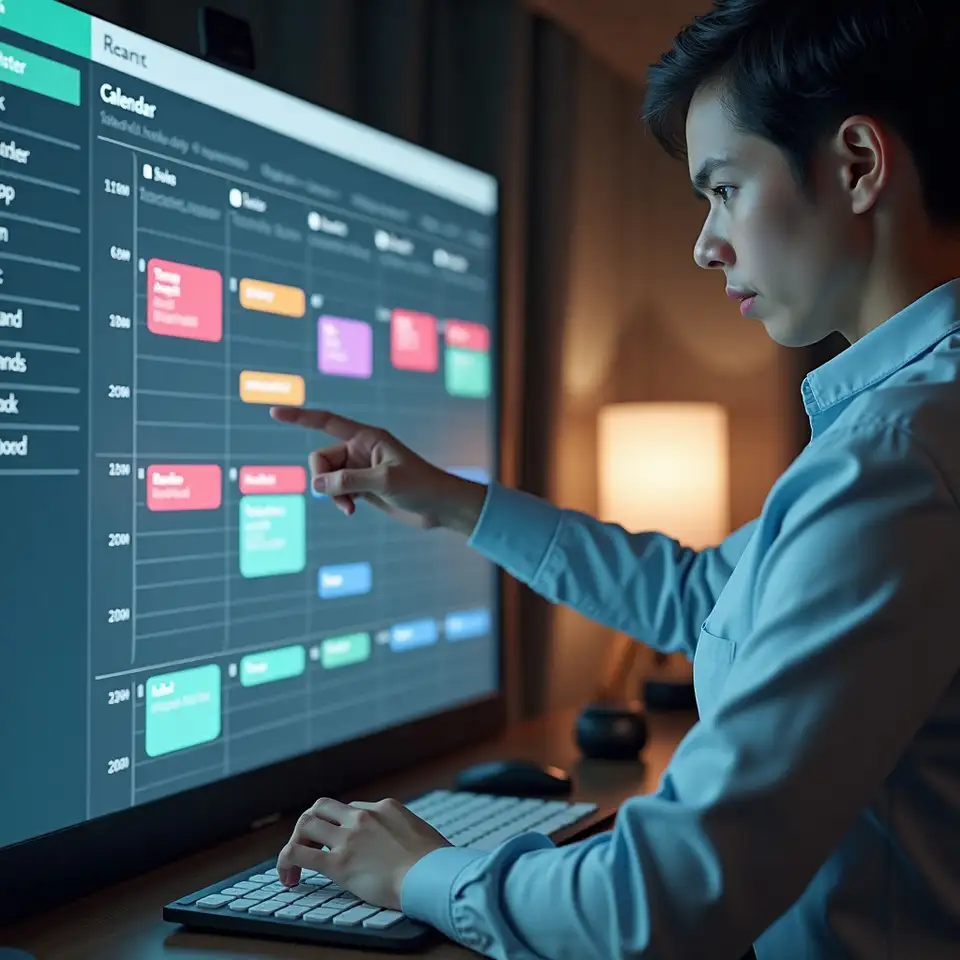
AI integrated focus scheduling at Sarivorelia begins with a simple premise: your attention is limited, and your calendars already contain clues about how it is spent. We work with AI assistants that read signals from multiple calendars and task systems, always within the boundaries you set. The assistant looks for realistic windows where interruptions are less likely and reserves focus blocks aligned with your stated energy levels. When a new meeting appears or a deadline shifts, it does not blindly reshuffle everything. Instead, it applies a small set of rules you have agreed to: which events are fixed, which can move, and how often deep work may be interrupted. Each change is logged with a short explanation so you can see what moved and why. Over time, we review which focus blocks held, which collapsed, and what that says about your work environment. We then adjust rules, connection settings, and notification patterns. The goal is not perfection; it is a schedule that bends gracefully when reality diverges from the plan, while still protecting a few meaningful blocks where you can think without constant switching. Because circumstances, tools, and habits differ widely, results may vary from one person or team to another.


Energy mapping
Energy aware focus
A key part of our approach is aligning focus blocks with your natural energy.
Instead of assuming you can do deep work at any hour, we help you sketch a
simple curve across your week that marks sharper and slower periods. The AI
assistant then prioritises high value tasks during stronger windows and keeps
lighter work for times when interruptions are more likely.
This is not a medical assessment or a strict rulebook. It is a working hypothesis that we revisit as your schedule evolves. By comparing when focus blocks survive against when they slip, we refine both your energy map and the assistant’s rules. Some weeks will still be unpredictable, and results may vary, but you gain a clearer sense of which hours are genuinely worth protecting.
Our practical framework for shaping your schedule
To make AI integrated focus scheduling feel practical rather than abstract, we rely on a simple internal framework. It breaks the work into a few stages you can recognise in your own week, from observing what already happens to refining rules as your context changes.
-
Observe your real week
We begin by looking at your existing calendar and task patterns. Which days routinely spill over, which meetings always move, and where focus time already appears by accident. This baseline helps us avoid designing rules that ignore the way your environment actually behaves under pressure.
-
Define simple rules
Next we co define a small set of rules that the AI assistant can follow. For example, you might mark certain meetings as non negotiable, allow some tasks to move within a two day window, and reserve one or two focus blocks on higher energy mornings. These rules stay visible and adjustable.
-
Let AI propose changes
Once rules are in place, the assistant starts proposing changes within those boundaries. It may shift a flexible task out of a newly scheduled meeting, shorten a lower priority focus block, or suggest an alternative slot later in the week. Each proposal comes with a short explanation so you can accept, reject, or refine it.
-
Review and refine together
Over time we review how your schedule behaved. We look at which focus blocks survived, which collapsed, and why. Together we adjust rules, connection settings, and notification patterns, accepting that results may vary from week to week as projects and personal circumstances shift.